Insights

et insightful and thought provoking tips from experienced professionals. Our expertise range from Taxation, Financial Planning, Business Business Valuation, Investment Management and Deal Advisory. Enjoy!

Retirement Planning: Securing Your Golden Years

Let’s face it, retirement is one of those topics we all know we should think about… but most of us don’t. It feels distant, even irrelevant, when you’re still building a career or running a business. But here’s the brutal truth: the single biggest financial mistake most people make is waiting too long to plan for retirement.


Pesapal v KRA - What the Ruling Really Means for Kenya’s Fintech Ecosystem

The court’s decision in the Pesapal vs KRA dispute is significant. At a high level it confirms a principle many in the fintech community have long argued: payment service providers (PSPs) that facilitate transactions are not necessarily suppliers of the underlying goods or services, and are therefore not automatically subject to VAT in the same way as the merchant whose goods are being sold.

M-Kopa vs KRA: A Landmark Ruling on Place of Effective Management (POEM) and Tax Residency in Kenya

The recent decision in the M-Kopa vs Kenya Revenue Authority case has set a significant precedent in Kenya’s corporate tax landscape, particularly on how Place of Effective Management (POEM) is determined for tax residency purposes. This case is not just about one company - it carries broad implications for multinational structures, tax planning, and compliance strategies going forward.

Why Investing in Knowledge Is the Smartest Investment You’ll Ever Make

Here’s a truth that often gets overlooked in the financial planning conversation: education is not just an expense - it’s an investment. But unlike most investments, this one has the power to shape generations. It determines careers, income potential, opportunities, and in many ways, the legacy you leave behind.

Stop Working for the Taxman: Keep More of What You Earn

We often talk about making money through careers, businesses, and investments, but the real measure of wealth lies not in what you earn but in what you keep. Taxes are the silent drain on most hardworking people’s fortunes, and without a strategy, they can swallow decades of progress. This edition explores how smart tax planning, financial structuring, and intentional choices can transform your financial journey - ensuring you keep more of what you’ve worked so hard to build.

Why Savings Alone Will Never Make You Wealthy

Investing is often seen as the exciting part of wealth building, but few people pause to consider how the numbers, the graphs, and the strategies actually connect to real-life financial goals. In this edition, we look at investing not as a gamble, but as a disciplined system for creating growth, balancing risks, and aligning with your long-term vision. With practical examples, we break down how to approach investments with clarity so that every dollar works harder for your future.

The Biggest Lie in Wealth Building: Thinking You're Safe Without Insurance

Insurance isn’t just a policy, it’s a financial safety net that protects what you’ve built and secures your family’s future. Too many people view it as an expense, when in reality it’s one of the most powerful wealth-preservation tools available. In this edition, we unpack how insurance ties directly into your financial plan, why it’s a cornerstone of smart wealth management, and how the right coverage can be the difference between financial resilience and financial ruin.

Why Earning More Money Won’t Solve Your Money Problems

Money in, money out - it sounds simple, but it’s where most people stumble. Cash flow management isn’t about how much you make, it’s about how well you control the movement of money through your life. In this edition, we reveal why earning more isn’t the magic bullet and why true financial freedom depends on mastering cash flow. Done right, it turns chaos into clarity, debt into opportunity, and income into lasting wealth. Without it, even high earners can end up broke.

Why do smart people make poor money decisions?

Wealth begins in the mind long before it appears in the bank account. How we think about money - our habits, fears, and decisions - directly shapes our ability to build and preserve it. This edition explores the psychology of financial success, how the brain processes financial choices, and why mastering your mindset is just as important as mastering tax codes or investment charts. When you learn to think differently about money, everything else starts to change.

Why Accumulation is the First Step in Financial Planning

Before wealth can grow, it must first be gathered. Accumulation is the foundation - the slow, deliberate process of building resources that later fuel investments, opportunities, and security. In this edition, we strip wealth-building down to its essentials: saving consistently, controlling expenses, and creating the discipline that sets the stage for everything else. Without accumulation, even the best investment strategy collapses. With it, the doors to financial freedom begin to open.

Democrats’ plans to make the wealthy pay a little more

The House Ways and Means Committee outlined plans on Sept. 13, 2021, to move the top marginal income rate up a couple of notches to 39.6% and to introduce a 3% surtax on incomes above $5 million. That proposal would fall short of calls to really “tax the rich,” as Rep. Alexandria Ocasio-Cortez’s dress demanded at a glitzy New York bash just hours later.

Google goes after KRA

In a suit that foreign firms with subsidiaries in Kenya will closely monitor, Google Kenya has asked the High Court to overturn a Tax Appeals Tribunal decision that barred it from demanding refunds for Value Added Tax paid between 2010 and 2013.

Financial advice a loss-making business: KPMG

Modelling by professional services giant KPMG has found the average cost to provide financial advice exceeds the price paid for that advice by 30 per cent, reigniting calls for red tape to be stripped from the troubled sector.

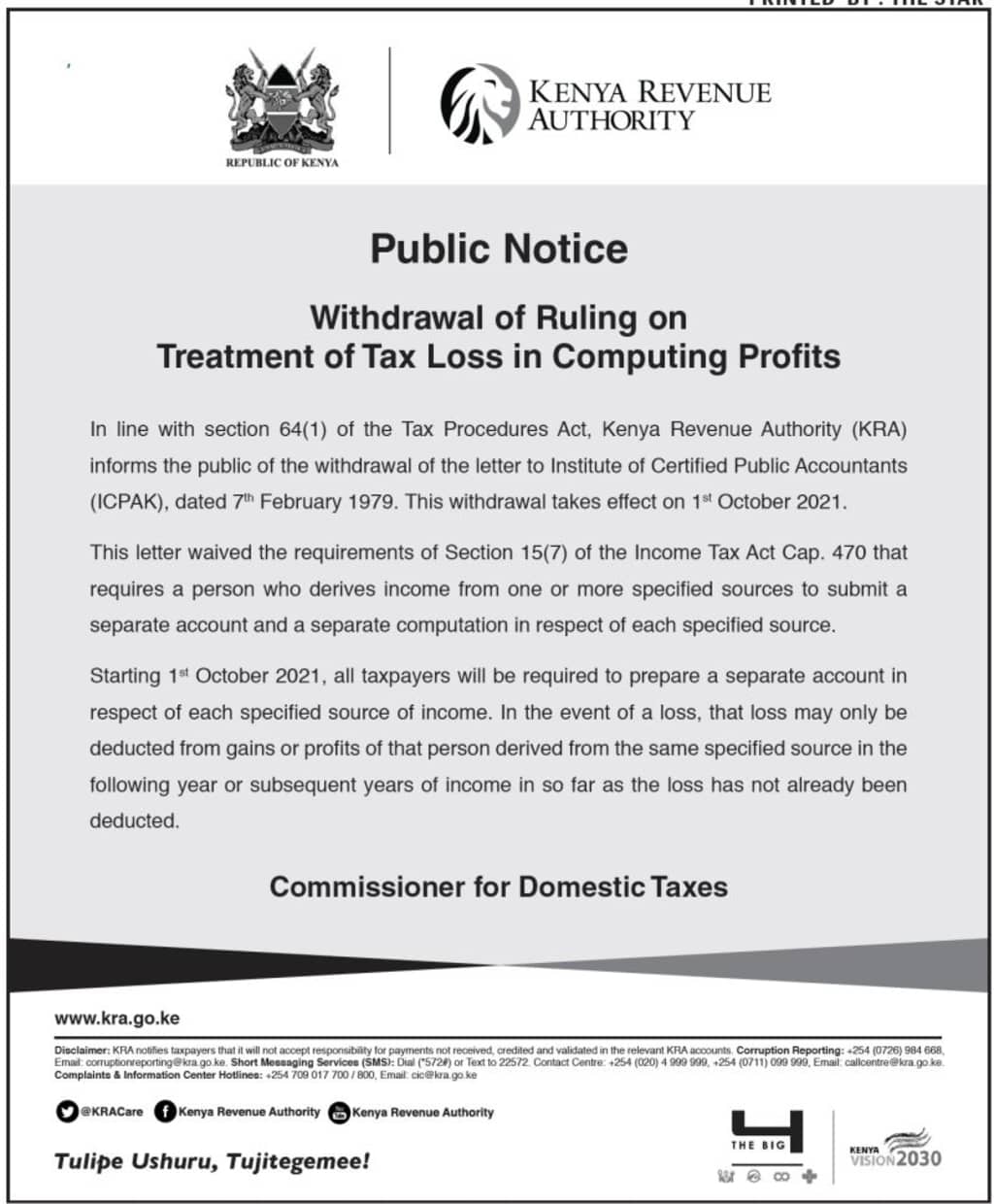
KRA Withdraws Public Ruling on Treatment of Tax Loss

Following the withdrawal of the letter to the Institute of Certified Public Accountants (ICPAK) dated 7th February 1979, which waived the requirements of Section 15(7)b of the Income Tax Act, companies will henceforth only be allowed to deduct any losses incurred from profits or gains derived from the same specified source of income in the following or subsequent years of income, for as long as the losses had not already been deducted.

"The average wealthy person spends 10 times more time planning their finances than the average middle-class individual." – Thomas J. Stanley

Start Now